
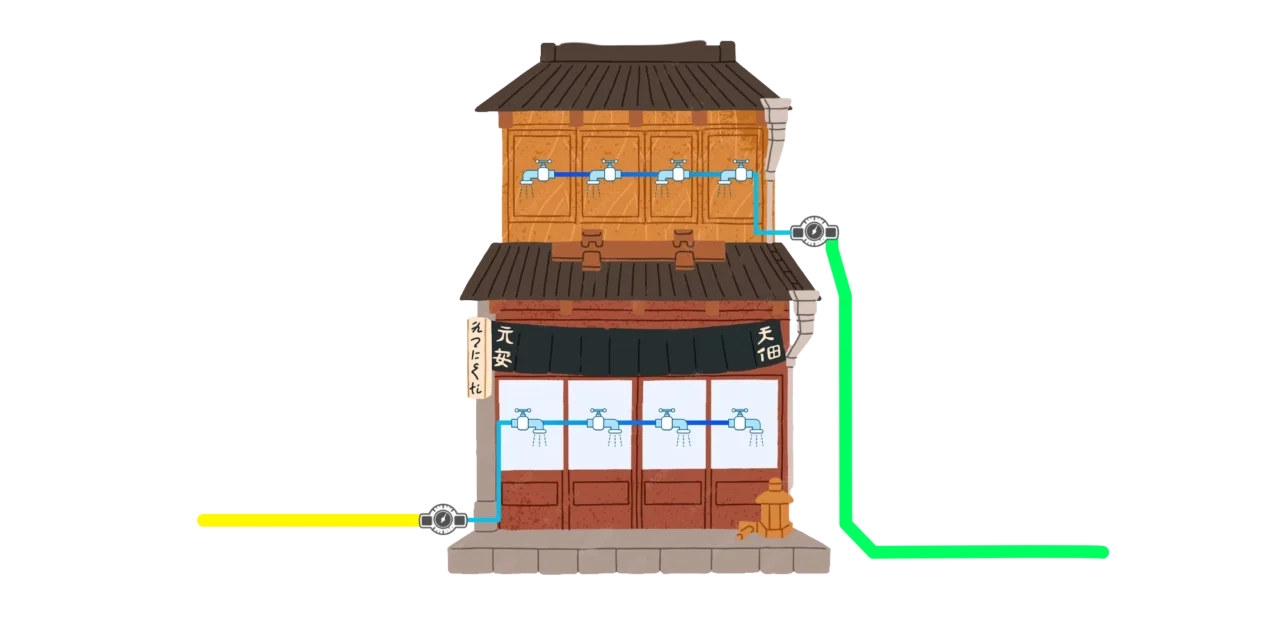
The magical old house in Tokyo
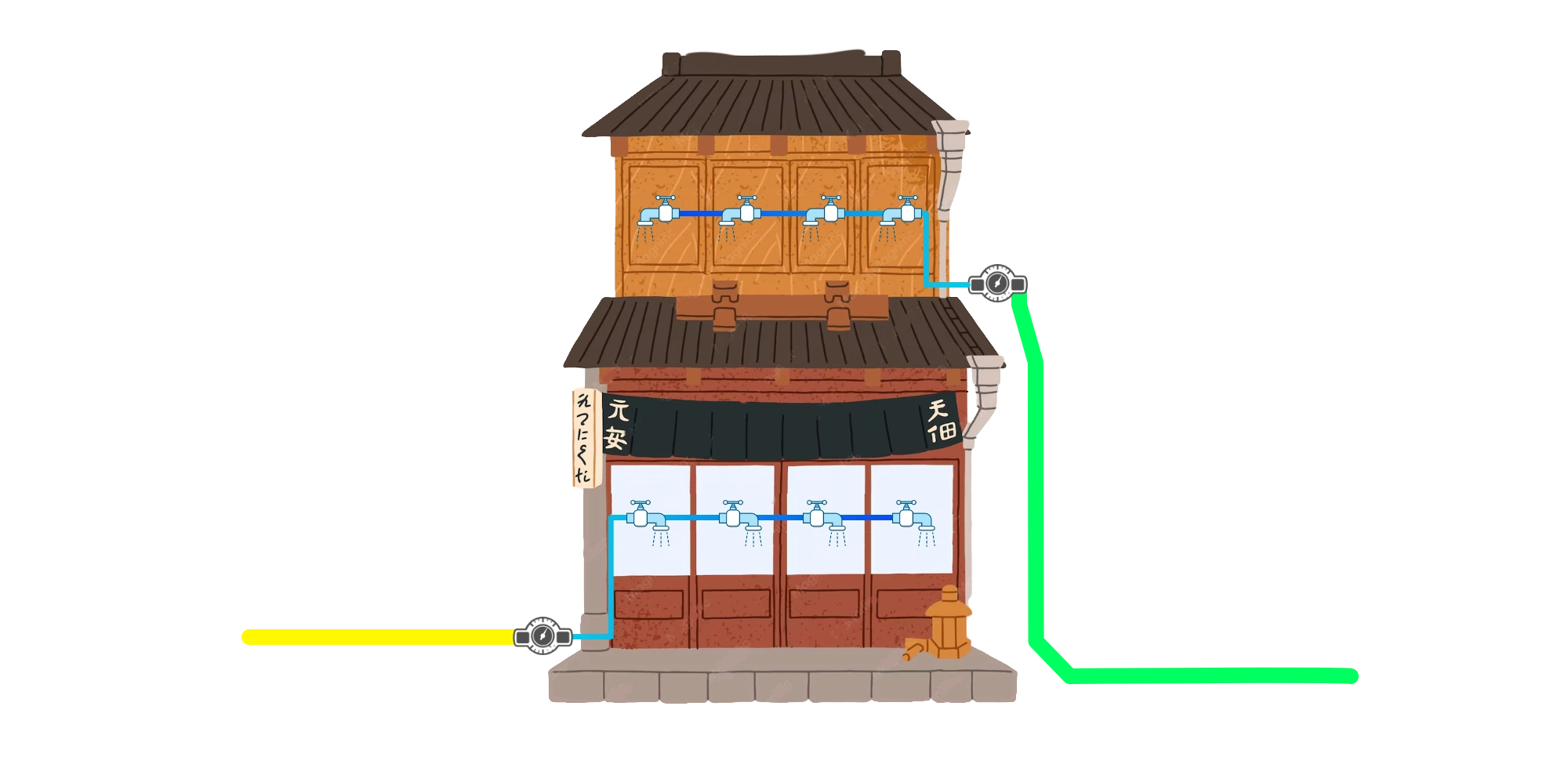
Our house is a magical, 700-year-old building in Tokyo. It has delicate old plumbing, a bathroom in every room, and the ability to add entire floors instantly.
The plumbing is designed to work at about five units of pressure. In our electrical metaphor, that is 5V.
It does not have to be exactly five to do anything at all, but it needs to stay within a safe range. Too little pressure means disappointing showers. Too much pressure can damage the plumbing.
The city connection
The city’s water main supplies water at 120 units of pressure—far too much for our delicate five-unit plumbing.
So, between the city main and our house, we install a pressure-converting station. That is our power adapter.
On the house side, it maintains about five units of pressure. It also has a maximum delivery capacity: how much water per second it can supply while maintaining that pressure.
Those are two different specifications:
• Volts describe the pressure.
• Amps describe the flow rate.
• The adapter’s amp rating describes its available flow capacity—not a flow it forces through every bathroom.
The guests control how much flows
Most of the year, only a few rooms are occupied. A few guests open their taps, so relatively little water flows.
When the house fills with guests and everyone showers at once, much more water flows. We still want approximately the same pressure at every shower.
Opening a tap farther represents making an LED brighter: it increases the flow it uses. Closing it represents turning the LED off.
A big supply does not force every shower to use its entire capacity. A connection capable of supplying ten buckets per second can supply just two when that is all the open taps use. The rest is unused capacity—not wasted water.
Even when every tap is closed, the pipes can remain pressurized. Pressure being present does not mean water is being consumed.
The long, narrow pipe problem
Now imagine that both floors receive water through one long, narrow pipe, with each bathroom branching off along the way.
When only one guest showers, everything seems fine.
When everyone showers, the shared pipe must carry much more water. Its resistance to flow causes pressure to fall along the route. Nearby bathrooms may still get decent showers, while the farthest bathrooms get weak streams.
The first floor does not flood because the upstairs guests opened their taps. Instead, the delivery route loses too much pressure while trying to serve everyone.
That is what can happen along a long LED strip: current flowing through the wires and copper traces causes voltage drop, leaving the farthest LEDs with too little voltage.
Adding a better delivery route
We can give each floor a separate, adequately sized delivery pipe from the same pressure-converting station.
Now the upstairs water does not have to travel through the downstairs distribution pipe first. Both floors have a better route to the supply.
That represents separate power branches or additional power-injection points.
But our station must still have enough total capacity for both floors. Better pipes cannot make an undersized station supply more than it can deliver.
And a bigger station cannot eliminate the problems caused by a long, undersized delivery pipe. We need both adequate supply capacity and adequate distribution.
Why we don’t just increase the pressure
If the upstairs showers are weak, turning up the pressure for the entire house is not a safe fix. The nearby plumbing may then receive more pressure than it can tolerate.
Instead, we keep the supply at the correct pressure and improve the delivery pipes.
For the LEDs, that means keeping the correct supply voltage and addressing current capacity, wire size, distance, and power-feed locations—not simply turning up the voltage.
Where the water metaphor stops working
Our electrical adapter has one magical ability that an ordinary water-pressure valve does not:
It can trade high voltage and low current on its input side for low voltage and higher current on its output side.
So five amps delivered to the LEDs does not mean five amps drawn from the wall. The adapter transfers energy between those two sides, with some losses; it does not preserve the same “water flow” through both sides.
Keep the plumbing picture for understanding pressure, demand, and delivery routes—but do not use it to equate the adapter’s input amps with its output amps.
The house rules
First, make the incoming pressure safe for the old plumbing.
Then, provide enough supply capacity and sufficiently good delivery pipes for all the guests.
More available flow capacity is fine: the guests use what they use.
Excessive pressure is not fine: the plumbing cannot simply choose to ignore it.
1. “Every faucet needs exactly 5V to work at all?”
Not exactly. Think “designed to work around five units of pressure,” rather than “exactly five or nothing.”
A 5V LED product has an acceptable voltage range that depends on its components. Too little can mean dimming, incorrect colors, or unreliable operation; too much can damage it. It is not an exact cliff at 4.999V or 5.001V.[adafruit +1]
2. “Amps are how much you open the tap?”
Yes—that is a useful analogy:
• Tap closed → LED off → little or no LED current.
• Tap partly open → lower brightness → lower average current.
• Tap fully open → maximum brightness → higher average current.
With addressable RGB LEDs, the selected colors also matter: lighting red, green, and blue together generally takes more current than lighting only one channel. There is a maximum operating demand, rather than one “optimal” current that every LED always wants. The supply must be able to meet the demand for the brightness and colors you choose.[adafruit]
3. “Which part makes the LEDs dim farther down the line?”
Your unfinished sentence was heading in the right direction:
“Bad plumbing can’t keep the pressure up while all that water is flowing.”
The electrical version is:
“Long, thin wires and strip traces can’t deliver all that current without losing some voltage along the way.”
For example, an illustrative—not predicted—result could look like:
Supply Start of strip Middle Far end
5.0V 4.9V 4.5V 4.0V
The farther LEDs receive less voltage, so they may become dimmer or change color. More current makes this voltage drop worse; thicker or shorter wiring and additional power-feed points can reduce it.[adafruit]
So it isn’t that the first LEDs “use up the amps.” It is that the shared delivery wiring loses voltage while carrying current.
4. “For burning them out, I always need an adapter?”
From a household wall outlet: yes, you need a suitable supply that converts wall power into the voltage your LEDs require. Never connect a 5V strip directly to mains.
But you do not need another adapter if your source already provides suitable regulated 5V DC with enough current capacity. The requirement is correct power at the strip—not an adapter for its own sake.[adafruit +1]
Your two-part checklist is:
Requirement
What you are solving
Correct voltage at the LEDs
Avoiding overvoltage damage and undervoltage malfunction.
Enough supply capacity and adequate wiring
Supporting the desired brightness without excessive voltage drop or overloaded wiring.
Both are necessary. A correctly rated 5V supply addresses the overvoltage problem, but it does not guarantee protection against every failure: reversed connections, shorts, transients, and wiring mistakes can still cause damage.[adafruit +1]
In your house metaphor: reduce the city pressure to the safe level first; then make sure the delivery pipes can keep that pressure reasonably steady when everyone showers.