Layers
cabinet floor
↓
4 rubber vibration pads
↓
removed shelf board (flat and rigid)
↓
distiller directly on the board
Placement
• Use four pads, near the four corners underneath the removed shelf board.
• Put the distiller centered over the board, with its feet directly on the wood.
• Make sure it is level and cannot rock; if it rocks, shim the board rather than stacking more soft material.
• Keep the board small enough that it does not block the airflow around the distiller’s upper vent band.
If it still rattles after that, the next improvement is a thin silicone/rubber mat between the distiller feet and the wood, but only if the machine stays level and stable. Start with the first arrangement—the mass board plus pads beneath is the cleaner setup.
cabinet take out shelf
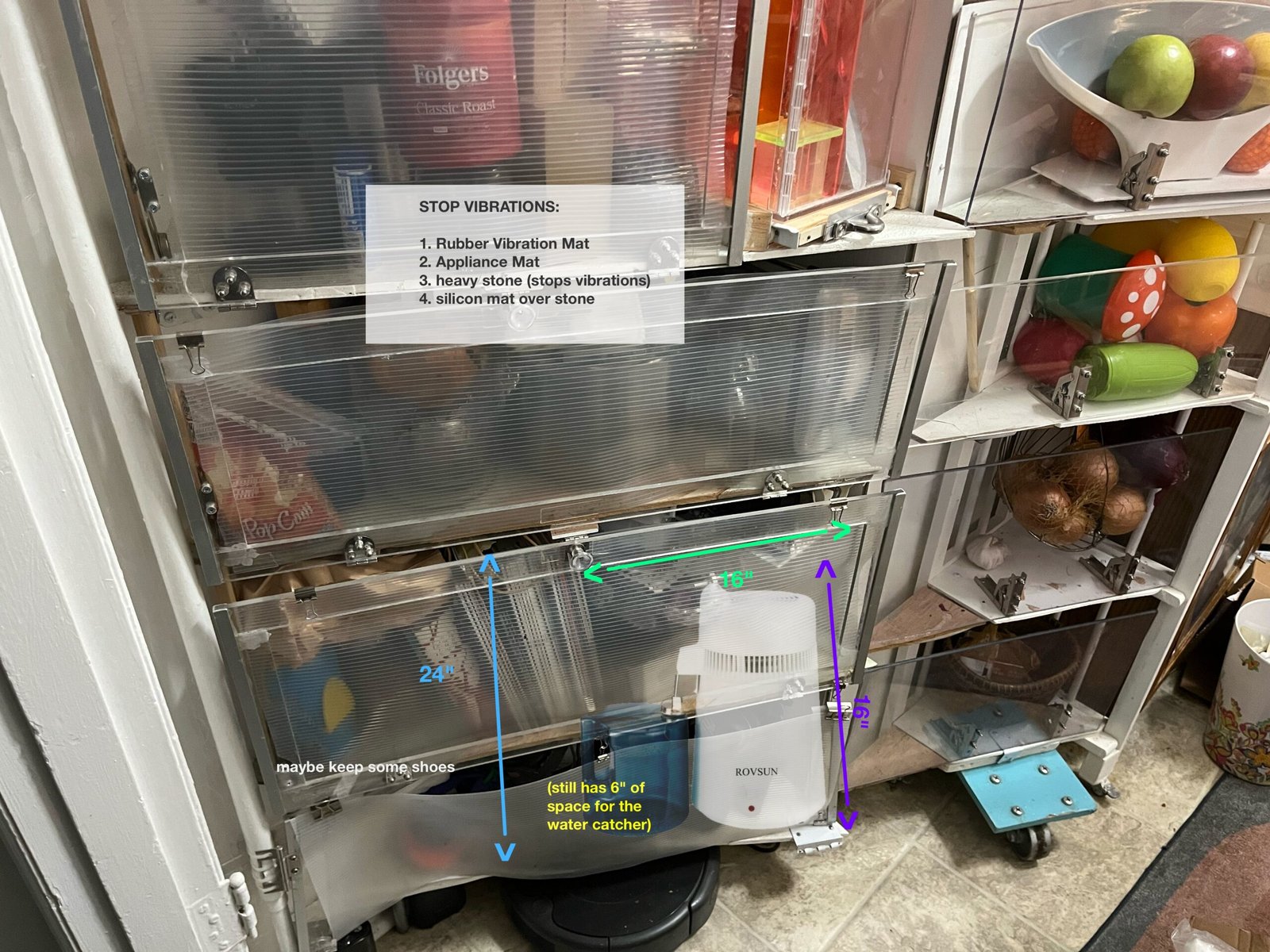
Ah—then that cabinet bay is a workable home for it. With the shelf removed you’ll have about 24 inches tall, giving the 15.3-inch distiller roughly 8–9 inches of overhead clearance, which is plenty for the upper fan vents.[tuttnauer +1]
Recommended setup
• Place the distiller on the four rubber pads, preferably on a rigid tray, tile, or board so the shelf does not resonate.
• Keep it on the right, as in your mockup; keep the catcher jug to the left/front.
• Leave the lower ribbed-plastic door open while it runs, or at least swung to the side—this gives the fan an easy exit path and creates some acoustic shielding.
• Keep about 4 inches of free space around the vented fan ring, especially at the back and sides.
• Do not put shoes or any other stored items in the remaining space next to it while it is on; reserve that area for the catcher and airflow.[tuttnauer +1]
Noise expectations
The pads plus a more rigid base may noticeably reduce any cabinet buzzing. The fan itself will still be audible, but the tall cavity and open angled door should prevent it from becoming a hot, echoing little box. You can test it with the door open at different angles: the quietest position that still feels cool around the vent band is the one to keep.[Attachment]
I would skip buying car sound mat or acoustic foam for now. Try the pads, removed shelf, and open door first—those address the practical causes without risking heat buildup.
They will help with vibration transmitted into the shelf/cabinet, but they will not cut most of the noise if what you are hearing is the distiller’s cooling fan. Those rubber pads can reduce the low buzzing/rattling that makes the whole cabinet act like a speaker; they cannot silence airborne fan noise.[Attachment +1]
Use the pads this way
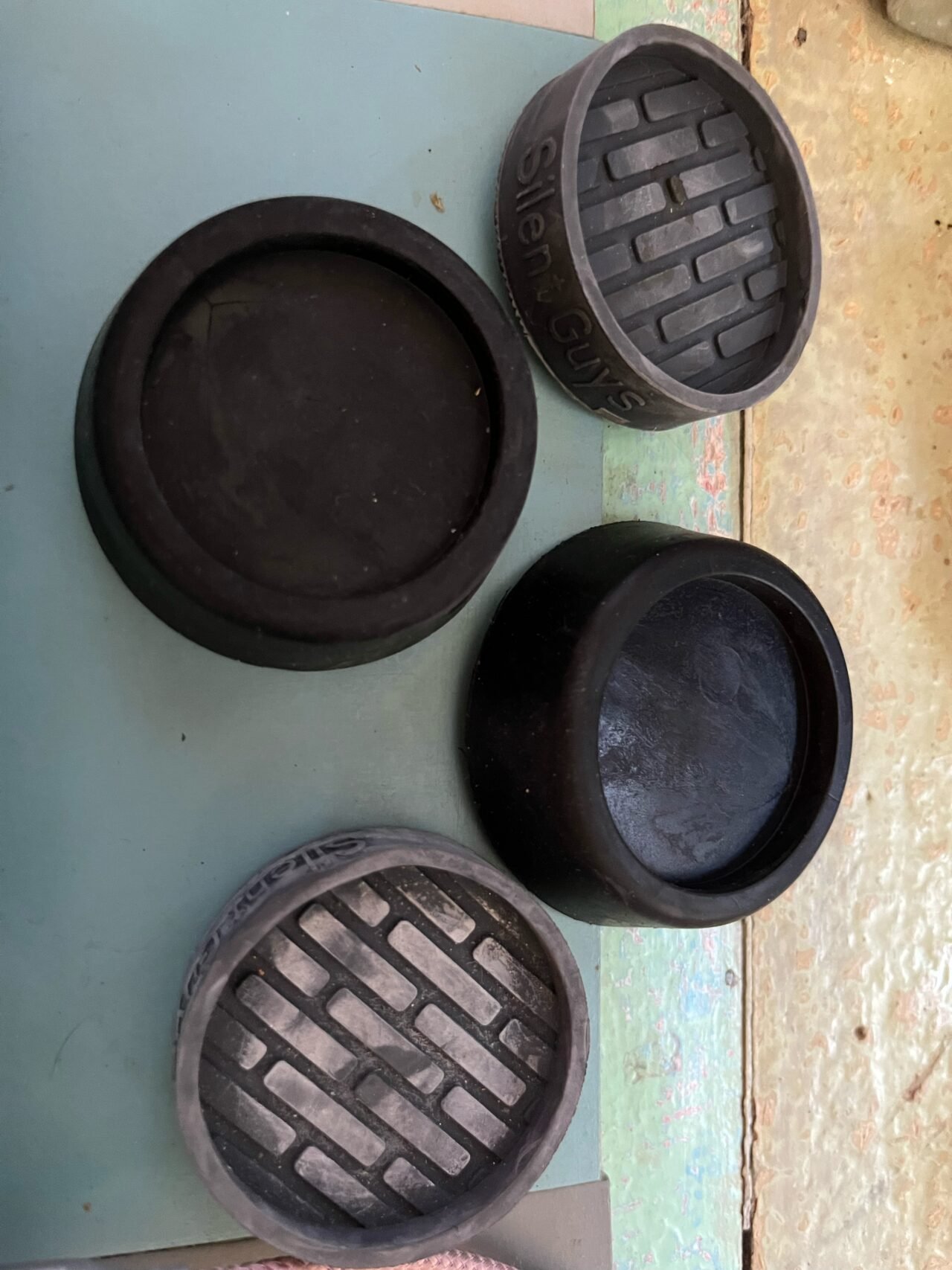
Use the four solid, flat round pads, one beneath each foot of the distiller. They look like the best choice from your pile because they give stable, even support. Avoid the deep treaded “Silent Guys” cups unless the appliance feet nest securely inside them—they could make the distiller wobble.[Attachment]
Put a thin, rigid board or tray on the shelf first if it is flimsy, then place the four pads under the distiller. The useful stack is:
shelf → rigid board/tray → four rubber pads → distiller
That prevents the large shelf panel from amplifying vibration while keeping the appliance level.
Do not enclose it tightly
The storage bay in your mockup looks large enough in width and height, but the distiller exhausts heat through the vent band around the upper body. Do not close it into a sealed cabinet or put sound foam directly around it—the fan needs open airflow, and the appliance is a 750 W heater.[Attachment]
Leave at least:
• About 4–6 inches of open space around the vented upper section.
• An unobstructed opening in front or behind for air to enter and leave.
• Nothing stored on top of it.
• The collector jug outside the hot-air path.
Your planned bay appears workable if the front remains open while it runs. The hinged clear door should be fully open during operation, not merely cracked.[Attachment]
Best first test
- Run it on the existing surface and lightly press down on the top/side—not on the vent openings—to see whether the pitch or rattling changes.
- Put it on the four flat pads and run it again.
- If the cabinet still booms, add a heavy concrete paver, stone tile, or thick MDF/plywood board on top of the pads, then put the distiller on that rigid mass.
The rubber isolates it; the added mass stops the shelf from behaving like a drum. If it remains loud after that, you are hearing mostly the fan, and cabinet placement will make it quieter only by containing/directing sound—not by fully eliminating it.
swhat bout fan noise?
For the fan noise, the cabinet can help—but only if you treat it as a sound shield with a big, clear airflow path, not as a closed box. The rubber pads won’t do much for the fan’s whoosh/hum; they only reduce vibration transferred into the shelf.[amca +1]
Best cabinet arrangement
Put the distiller toward the back half of the shelf, with its front and upper vent ring completely unobstructed. Leave the clear cabinet door fully open while it runs, and keep at least 4 inches of free air around the unit’s sides/back and above it. Countertop-distiller guidance specifically calls for that clearance so the fan can cool the condenser properly.[tuttnauer +1]
For noise direction, the cabinet’s side panels and top will block some direct fan sound from reaching the room. The open front will still emit sound, but it will be lower and less “all over the kitchen” than having it out in the open.
Quietest safe trick
Make a removable baffle, not a sealed enclosure:
• Put a rigid board or the cabinet’s clear door panel in front of the unit but offset to one side, leaving a wide 4–6 inch air gap at both the bottom and side.
• Aim it so there is no straight line from the upper fan vent to where you sit.
• Line only the inside face of that separate baffle with a thin, fire-retardant acoustic material—or even a dense moving blanket kept well away from the machine—not inside or against the distiller itself.
• Keep the top, side vents, and front intake/exhaust path open.
This makes the sound bend around an obstacle while air still travels freely. Do not place foam, fabric, cardboard, or plastic across the distiller’s vents.[manuals +1]
Check for abnormal noise
A steady fan whoosh is normal on these 4 L budget distillers; user feedback specifically notes that the ROVSUN’s fan can be noticeable and that it emits heat. But stop and inspect it if you hear:[amazon]
• Metal scraping, a rhythmic tick, grinding, or a sudden rattle.
• A fan whose sound changes when the top cover is gently steadied.
• Strong vibration that remains after using the pads.
• Little or no warm air coming from the top while it is running.
Those point to a loose cover, fan blade contact, or an airflow/fan fault rather than ordinary fan noise. Fan and vent blockage can also cause poor condensation and pressure/noise problems.[mypurewater +1]
so those cabinets are jsut a acrylic frame with soem heavy duty ribbved plastic shelf papaer binder clipped to the frame open or close they a re in nowy airtight.
That is much better than a sealed cabinet, and it means the enclosure itself is not the safety problem. But the plastic panels still create a partial sound box and may trap hot exhaust if all sides are shut, so run the distiller with its front panel open or removed.[mypurewater +1]
What this means
Your ribbed plastic/acrylic setup can be useful because it will block a little direct fan noise and keep the appliance visually contained—but it is not acoustic insulation. The fan needs room to pull cooler air in and dump warmed air out; water-distiller guidance consistently says to leave about 3–4 inches of open clearance around the unit and not operate in a closed or confined cupboard.[mypurewater +2]
For your bay, the practical setup is:
• Place the distiller on the anti-vibration pads.
• Leave its front clear door fully open while operating.
• Keep the shelf/panel above it open or lifted if it is within a few inches of the top vent ring.
• Keep a clear gap at the back or side so warm air can escape, rather than being trapped against the acrylic.
• Keep the water jug where it cannot obstruct the fan vents or touch the hot machine.[Attachment +1]
For fan noise
The cabinet sidewalls will take the edge off by blocking the direct path of sound. The best additional quieting move is to place a loose, rigid side baffle outside the air path—for example, a small acrylic panel positioned off to the side/front, with a large gap around it—so the sound has to turn a corner before reaching you.
Do not cover the vent band, put foam/fabric inside the bay while it runs, or close the clear panel “most of the way.” That risks recirculating the unit’s hot exhaust, making the fan work in hotter air and potentially reducing water output.[precisionwaterusa +1]
a loose, rigid side baffle outside the air path – i don’t undersand – can you show me what you mean?
I would not add a baffle in that cabinet—your open ribbed-plastic door already is the baffle I meant. You have a good arrangement available: leave the front door open at roughly 45–90 degrees while the distiller runs, rather than closing it.[Attachment]
Like this from above:
TOP VIEW — door open
back of storage bay
┌─────────────────────────┐
│ [ DISTILLER ] │
│ fan vents │
│ │
└────────────┐ │
│ open │
│ door │
│ / │
│ / │
└/───────────┘
room
The open door/panel blocks the straight shot of fan noise toward the room, but it leaves a huge path above, below, and around the panel for air to move. The sound has to “turn a corner”; the hot air can still escape freely.
Your exact layout
• Put the distiller on the right side as you mocked up.
• Put the water catcher on the left/front, leaving its spout path clear.
• Keep the lower front panel swung open, preferably toward the left, so it is between the upper fan band and the room’s main listening area.
• Leave the space above the distiller clear—no shoes, bins, or a closed panel immediately above it.
• Do not add a second board beside the fan; the open door is enough and safer.[Attachment]
Your bay is about 24 inches wide and 16 inches tall, while the unit is about 15.3 inches high. That only leaves roughly an inch of height under the shelf above—not enough for the distiller to run safely in that exact orientation. The fan’s vent band sits near the top and needs free room around it, so you should remove or raise the shelf directly above that bay, or instead use the larger/taller opening above it.[tuttnauer +2]